
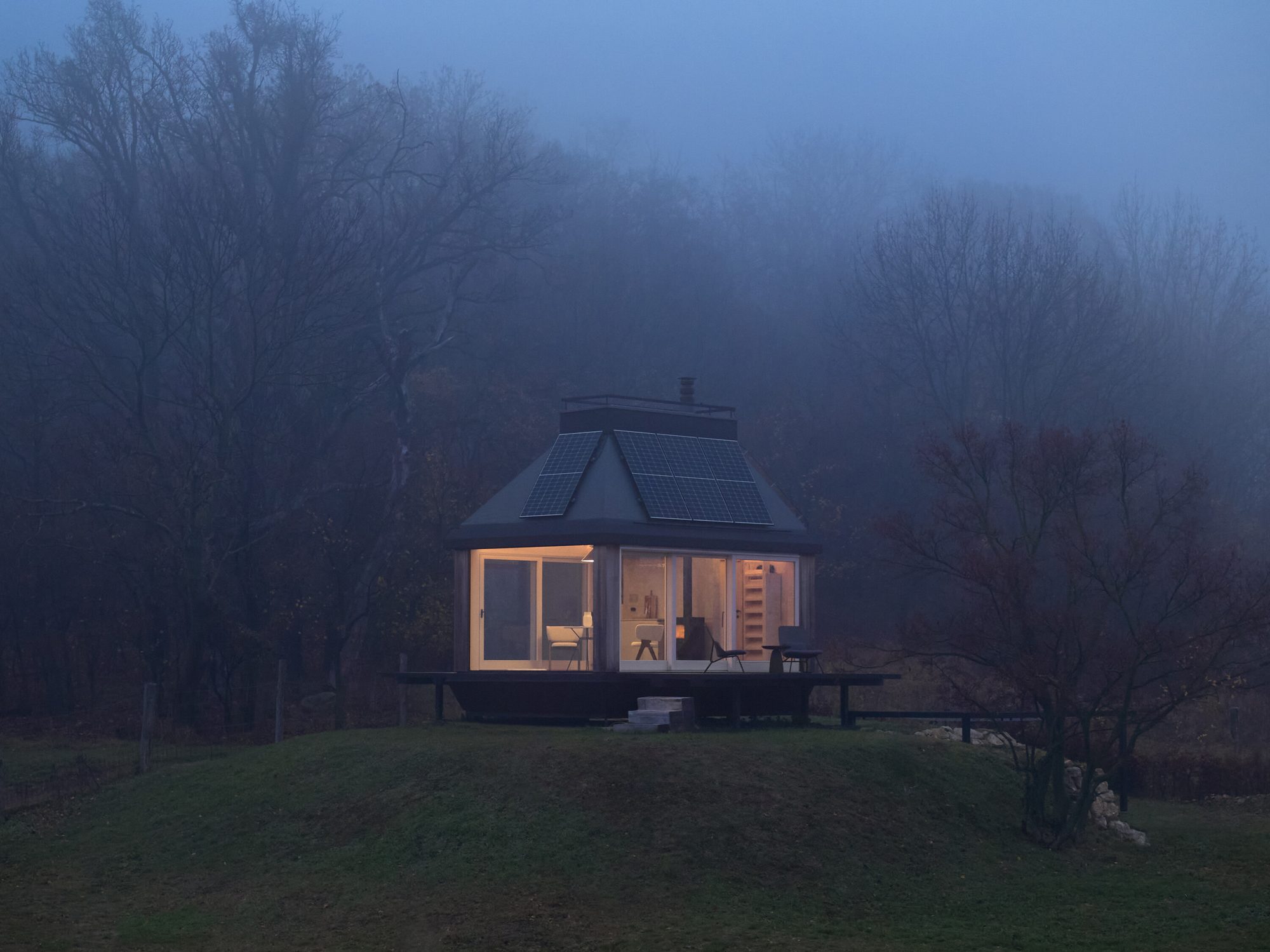
Cabin Devín is a compact off‑grid retreat positioned on a grassy hill above the vineyards of Devín near Bratislava, Slovakia. Designed by Ark‑Shelter and Archekta, the small dwelling condenses living, sleeping, and service functions into a structure of just 20 square meters. Through operable façades, vertical spatial compression, and a carefully controlled material palette, the cabin operates as both a shelter and a viewing instrument, framing the surrounding vineyards and the distant alpine horizon while maintaining technological independence in a remote landscape.
Cabin Devín Technical Information
- Architects: Ark-Shelter, Archekta
- Location: Devín, Bratislava, Slovakia
- Gross Area: 20 m2 | 215 Sq. Ft.
- Project Years: 2023 – 2024
- Photographs: © BoysPlayNice
The cabin is conceived as a small refuge closely connected with the surrounding landscape, where the boundary between interior and exterior can dissolve and expand daily life into the vineyard horizon.
– Martin Mikovčák




Site, Landscape, and Strategic Positioning
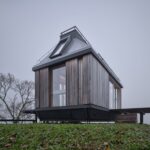
The cabin stands on a grassy rise overlooking the Zlatý Roh vineyards on the outskirts of Devín, a setting defined by open fields, distant hills, and shifting atmospheric conditions. Rows of vines extend across the slope toward a hazy alpine horizon. Seasonal fog often envelops the landscape, softening visual boundaries and reinforcing the sense of distance. Within this context, the structure operates as a small observational device, directing attention outward while maintaining a sense of physical refuge.
The building rests on a raised steel base that minimizes ground disturbance and creates a slight separation from the terrain. This elevation produces a floating presence while protecting the structure from moisture and allowing airflow beneath the floor. Access occurs via a narrow path leading upward through the vineyard edge and a stone retaining wall that forms a subtle threshold between cultivated land and the cabin’s immediate clearing.
The hilltop location reinforces the theme of retreat. Panoramic views extend over rows of vines toward the setting sun, while a solitary tree near the cabin acts as a visual anchor within an otherwise open field. Rather than dominating the site, the modest scale of the architecture allows the surrounding landscape to remain the primary spatial condition.
Compact Spatial Organization and Vertical Compression
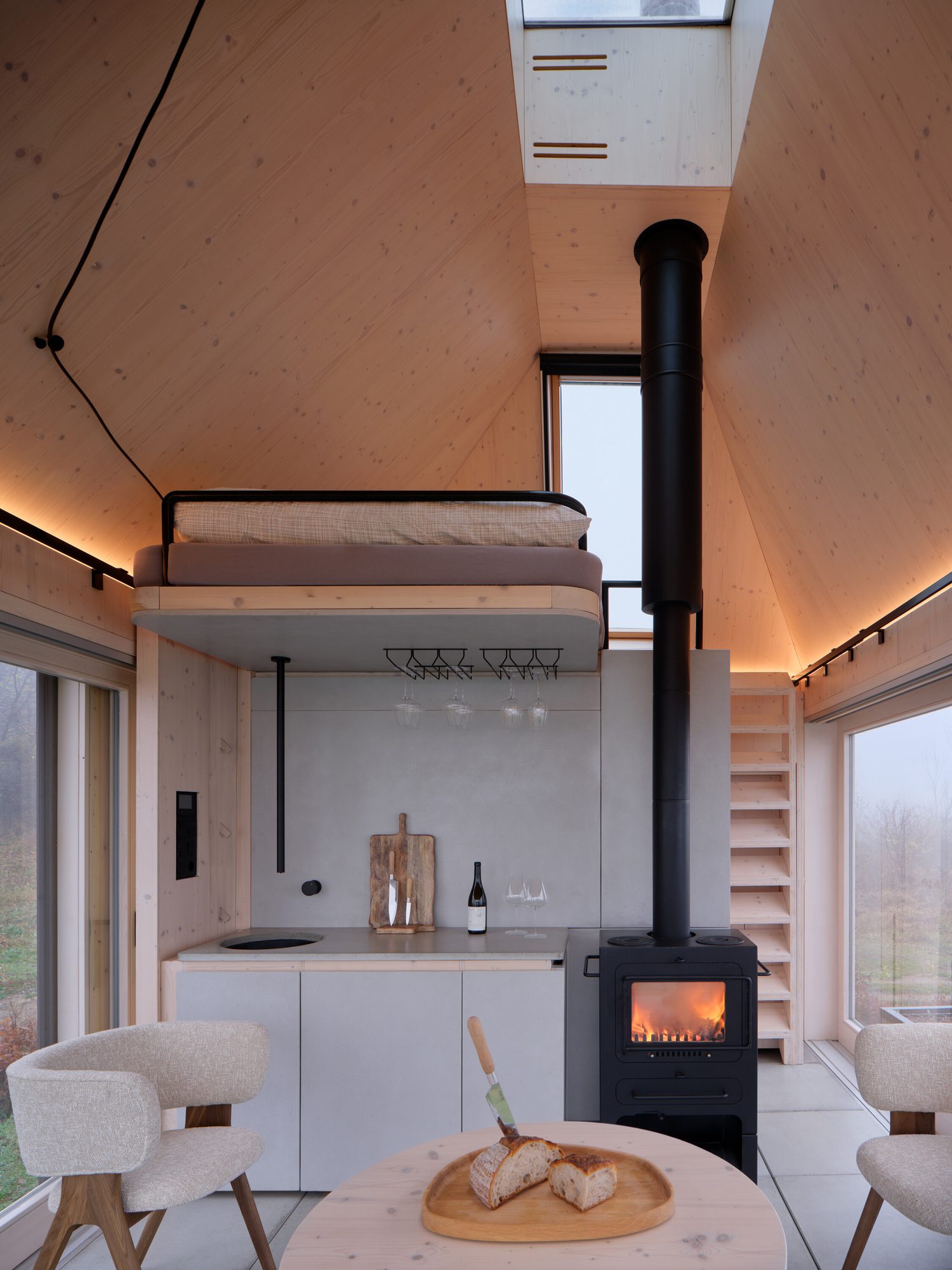
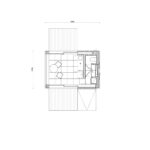
Within a footprint measuring just 5.4 by 3.7 meters, the interior organizes daily functions in a linear sequence aligned with the primary view. The living and dining area occupies the front of the plan where two glazed façades meet, enabling diagonal perspectives across the vineyards. Behind this open zone sits a compact kitchenette integrated into built‑in cabinetry, while the bathroom forms a more enclosed volume at the rear of the structure.
Vertical compression provides additional spatial capacity without enlarging the footprint. A sleeping loft occupies the upper volume beneath the roof, leaving the ground floor open for daytime use. This stacked arrangement produces contrasting atmospheres. The lower level remains outward-looking and transparent, while the loft is enclosed by the timber roof envelope and receives light primarily through a single skylight.
Transformable elements help maintain visual clarity in the small interior. A retractable wooden ladder integrated within the cabinetry appears only when access to the loft is required. A pendant lamp suspended from the upper level can be lowered to illuminate the living space and then lifted to reveal the sleeping area above. These mechanisms allow the cabin to shift between day and night configurations without introducing permanent spatial obstacles.
Threshold Architecture: Operable Façades and Expanded Living Space
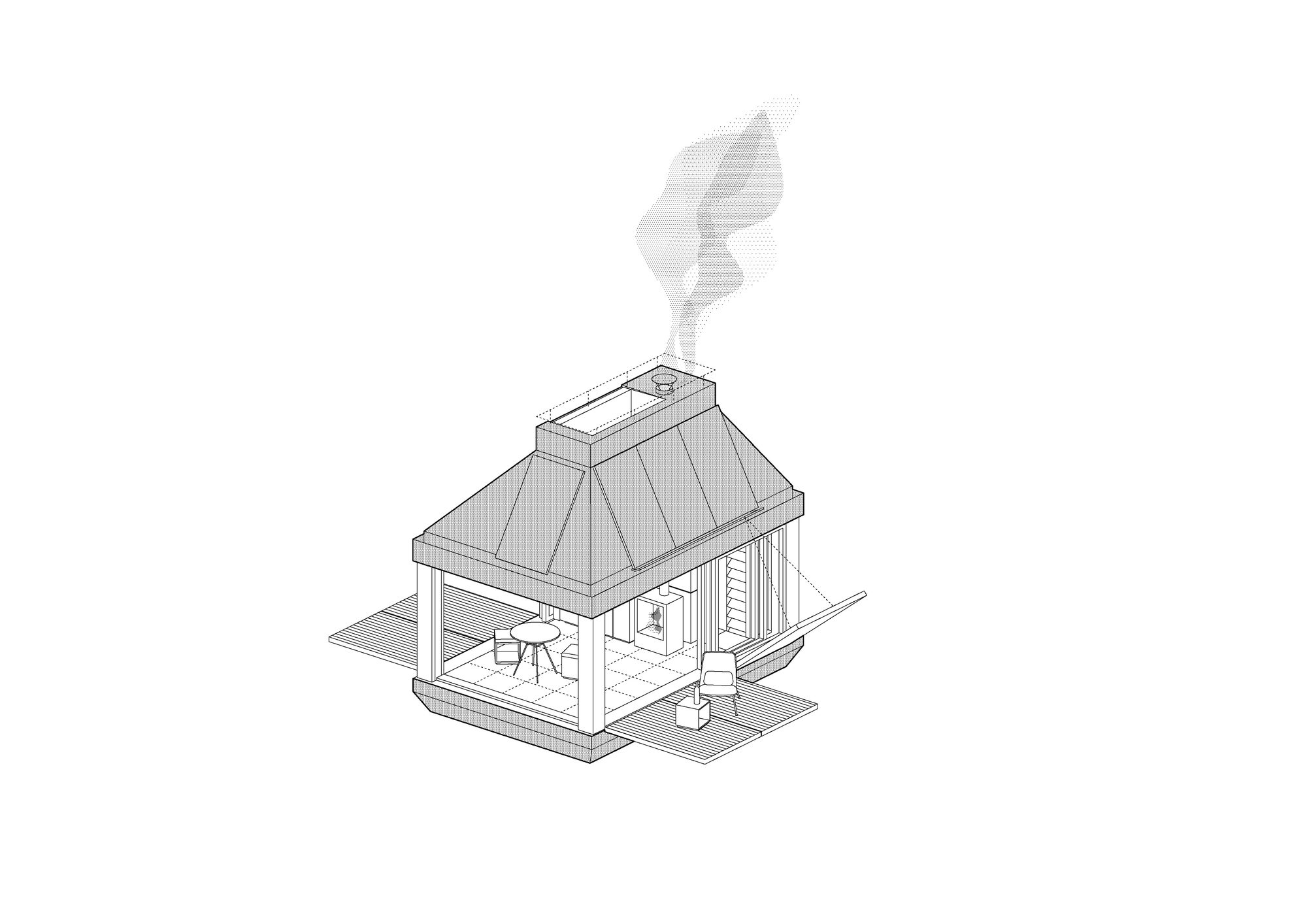
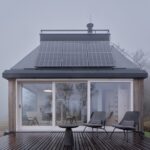
The relationship between interior space and the surrounding vineyard is mediated through operable façade elements. Two sides of the cabin include fold‑down timber terraces hinged to the base structure. When lowered, these surfaces serve as exterior platforms while simultaneously revealing the full‑height sliding glass walls behind them. The action transforms the compact dwelling into an open structure oriented toward the landscape.
With the terraces deployed, daily activities extend across the threshold between inside and outside. Seating and small furnishings occupy the timber decks, allowing the living area to spill outward and visually multiply the limited interior floor space. The corner position of the glazing creates uninterrupted views in two directions, further dissolving the perception of enclosure.
This system establishes a clear contrast between openness and protection. The transparent façades frame expansive views and admit daylight, while the roof envelope above remains solid and protective. The cabin, therefore, balances exposure with retreat, offering both panoramic observation and a sheltered interior volume.
Material Atmosphere and Off‑Grid Environmental Systems
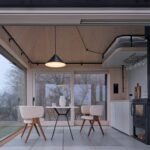
The interior atmosphere is shaped by a continuous envelope of bio‑based spruce wood panels that follow the geometry of the hip roof. Their pyramidal arrangement draws the eye upward and reinforces the vertical compression of the compact volume. The warm tone of the wood contrasts with the cooler cast-concrete flooring, establishing a tactile dialogue between lightness and weight in the small space.
Concrete elements appear at key moments of use. The floor surface adds durability and thermal mass, while a custom cast-concrete sink set directly within a window frame aligns routine activities with framed views of the surrounding vegetation. The combination of natural timber, mineral surfaces, and precise detailing reduces visual clutter while emphasizing the presence of materials.
Despite its remote location, the cabin operates year-round through a fully autonomous energy system. Roof‑mounted photovoltaic panels supply electricity that is stored in batteries, supplemented by a gas backup system that automatically activates when energy demand exceeds stored capacity. Ventilation and shading are regulated through automated controls that manage heat gain, airflow, and humidity. In summer, cooler air is drawn from beneath the raised floor while warm air is exhausted through the roof skylight. During winter months, the system operates in reverse, maintaining stable interior conditions without reliance on external infrastructure.











About Ark-Shelter & Archekta
Ark-Shelter is a modular architecture studio and workshop founded in 2015 by Martin Mikovčák and Michiel De Backer, who met at KU Leuven in Ghent, Belgium. With offices in Lichtervelde, Belgium, and Čadca, Slovakia, the studio develops prefabricated architectural modules that respond sensitively to landscape and context. Over time, Ark‑Shelter has realized hundreds of modular structures across Europe. Cabin Devín was developed in collaboration with Viktor Mikovčák’s Bratislava‑based studio Archekta, whose practice focuses on architectural projects at broader scales. Together, the studios explore modular construction as a flexible system that respects the genius loci of a place while emphasizing the biological and sensory experience of space.
Credits and Additional Notes
- Structural engineers: Radovan Hnidka
- Client: Cabin Devín
- Construction company: Ark-Shelter – realization of the module and built-in furniture
- Carpenter: Mário Cyprich
- Artworks: Stanislav Mikovčák
- Glass: VAK
- Loxone system and solar panels: PV SERVICE PLUS
- Photography: BoysPlayNice

